Table of Contents
Let’s picture this: you, the blackjack table, and your inner voice basically screaming: “Do I hit or stand? Maybe double down? Split?”
Feels like your usual Tuesday night scenario? Been there, back in the ’00s when I first started with blackjack. Trust me, guys, nothing sharpens your mind more than facing the dealer’s sneaky 16.
I’ve spent years turning my passion for blackjack into practical guides, and here’s another one: the basic blackjack strategy chart guide you’ve been looking for. I’ll tell you how to actually use it, not just scan it. I want you to think like a proper player, not just memorise the chart and call it a day. Find below your cheat sheet for optimal blackjack strategy.
Do You Really Need a Strategy?
Here’s a ‘thought’ I spotted long ago on Reddit from a player, and it just stuck with me – blackjack is built for you to lose by default (like any other casino game), and the basic strategy doesn’t flip the house edge, but even so, it’s the best way to cut your losses over time.
Ok, so first of all, blackjack is one of the few casino games that rely on strategy – your strategy (and skill). Yeah, it might look simple – you hit, stand, maybe split if you’re feeling it. But if you’ve been playing blackjack for a while now, you’ve probably noticed that there’s more to it.
Now, why waste your time trying to figure out the perfect strategy when there’s already one that pros use? The best part is that you can find the basic blackjack strategy chart everywhere online. And no, it’s no joke. It literally tells you the best (mathematically) move for every single possible scenario – based on the dealer’s upcard, of course.
Just before you roll your eyes – no, there’s no need to put in some effort and memorise it all. If you’re consistent, you’ll easily learn the main moves; the rest will stick with you naturally.
Meet Your Basic Blackjack Strategy Chart
Did you know that there’s no one-size-fits-all? It’s a matter of: number of decks, dealer hits or stands on soft 17, doubling after split (allowed or not), and optional rules (like early or late surrender).
I’ll share with you the most commonly used basic strategy chart for: 4-8 decks, dealer hits on soft 17, doubling after split is allowed, and late surrender is optional.
| Your Hand | Dealer’s 2 | 3 | 4 | 5 | 6 | 7 | 8 | 9 | 10 | A |
|---|---|---|---|---|---|---|---|---|---|---|
| Hard Totals | ||||||||||
| 8 or less | H | H | H | H | H | H | H | H | H | H |
| 9 | H | D | D | D | D | H | H | H | H | H |
| 10 | D | D | D | D | D | D | D | D | H | H |
| 11 | D | D | D | D | D | D | D | D | D | D |
| 12 | H | H | S | S | S | H | H | H | H | H |
| 13-16 | S | S | S | S | S | H | H | H | H | H |
| 17 | S | S | S | S | S | S | S | S | S | S |
| 18+ | S | S | S | S | S | S | S | S | S | S |
| Soft Totals (Ace + other) | ||||||||||
| A,2 / A,3 | H | H | H | D | D | H | H | H | H | H |
| A,4 / A,5 | H | H | D | D | D | H | H | H | H | H |
| A,6 | H | D | D | D | D | H | H | H | H | H |
| A,7 | S | D | D | D | D | S | S | H | H | H |
| A,8 | S | S | S | S | S | S | S | S | S | S |
| A,9 | S | S | S | S | S | S | S | S | S | S |
| Pairs | ||||||||||
| A,A | P | P | P | P | P | P | P | P | P | P |
| 10,10 | S | S | S | S | S | S | S | S | S | S |
| 9,9 | P | P | P | P | P | S | P | P | S | S |
| 8,8 | P | P | P | P | P | P | P | P | P | P |
| 7,7 | P | P | P | P | P | P | H | H | H | H |
| 6,6 | P | P | P | P | P | H | H | H | H | H |
| 5,5 | D | D | D | D | D | D | D | D | H | H |
| 4,4 | H | H | H | P | P | H | H | H | H | H |
| 3,3 & 2,2 | P | P | P | P | P | P | H | H | H | H |
Note: If ‘late surrender’ (not shown in table) is allowed, it should be considered before any of these, when surrender is the optimal decision.
How to Use this Cheat Sheet Like a Pro
Even beginners can turn these strategies into a real game plan if they use this chart correctly.
When to Hit, Stand, or Double – Hard Hands Explained
Know those tricky situations when you don’t have an Ace? The choice you make can either break or make your night at the blackjack table.
Now, stop second-guessing and take a peek at the chart.
Hit: When you hand totals 8 or less. No point in standing on 6, so don’t get cute. Yes, it’s a bit trickier with totals 12-16, but if the dealer shows a 7 through A, you’re gonna hit again. Having doubts? You’re more likely to lose if you just sit around and hope the dealer busts. Don’t you think?
Stand: Don’t even think of doing something else when you have a hard 17 (or higher). No need to be a hero. The odds of you busting are just too high. Plus, you’re already in a decent spot. Even if your total is 12-16, and the dealer’s showing 2-6, stand. You’re basically letting them busting with no extra effort.
Double Down: If your total is 9,10, or 11 (the dealer’s card is weak, say 2-6). The odds are already in your favour. But if the table limits your double, just play a casual hit.
And hey, you can get as clever as you want (if you think you can outsmart the chart), but those rules are there for a reason.
Aces Are Your Best Buds at Soft Hands
You know this, right? A soft hand is when an Ace counts as 11 without busting. Something like A + 6 (that’s a soft 17). Nice.
Now, did you know Aces are actually your wild cards? Here are a few most common scenarios:
- Soft 13-14 (A + 2 or 3) & dealer shows 5 or 6: double down (the dealer’s close to bust); otherwise hit.
- Soft 15-16 (A + 4 or 5) & dealer has 4-6: double down (same logic); otherwise hit.
- Soft 17 (A + 6) & dealer shows 3-6: double down (classy); otherwise hit.
- Soft 18 (A + 7) & dealer’s 3-6: double down; dealer’s 2, 7, 8: stand; dealer’s 9-A: hit.
- Soft 19+ (A + 8-9): Just stand.
When to Split Without Sweating It
The key rule here is: don’t panic.
The thing is that you can split two cards of the same value into two hands. The rule of thumb goes like:
- Always split Aces and 8s.
- Never dare split 10s or 5s.
- Situational rules: Split 2s and 3s if the dealer has 4-7. Only split 6s against 3-6. And if the dealer shows 2-7, you can split 7s as well.
Double Down Without the Drama
Or, when to go all in smartly?
So, go for it when:
- Hard 9 (if the dealer has 3-6). Anything else? Just hit.
- Hard 10 (against 2-9). The dealer got a 10 or an Ace? Hit, bud.
- Hard 11 (double in almost all cases unless the dealer has an Ace up its sleeve).
- Soft 16-18 (when the dealer’s upcard is 4-6). Otherwise, hit.
What NOT to Do – Most Common Mistakes
First of all, we’ve all been there. And if you find out you’re doing anything from what I list below, no worries. That’s what this guide is here for.
Anyway, where was I? Avoid these at all costs:
- Ignoring the strategy chart and guessing your next move (biiiig red flag).
- Misunderstanding splitting and doubling (that’s what the chart’s for).
- Taking insurance (oh, that’s a trap and losing move, telling you right away).
- Getting distracted (chatting too much or watching other players’ drama will make you lose focus, which is unacceptable in a game of strategy).
- Not paying attention to dealer rules (like I said, not all blackjack tables are the same, so check for rules way before you start playing).
- Doubling down after a losing streak (spoiler alert: it very rarely ends well).
Best Sites to Use The Basic Blackjack Strategy Chart














Bottom Line: Master Your Chart Like a Boss
So yeah, that’s the gist: the basic blackjack strategy chart isn’t a magic tool, but it might tell you how to play your cards right if you put in just a bit of effort.
But before you go and try practising it, I have a few practical pointers for you: keep the chart at hand; start by memorising the main moves (the rest will follow suit); don’t get greedy, thinking you can outsmart the system. The best piece of advice you’ll ever hear is to be consistent.
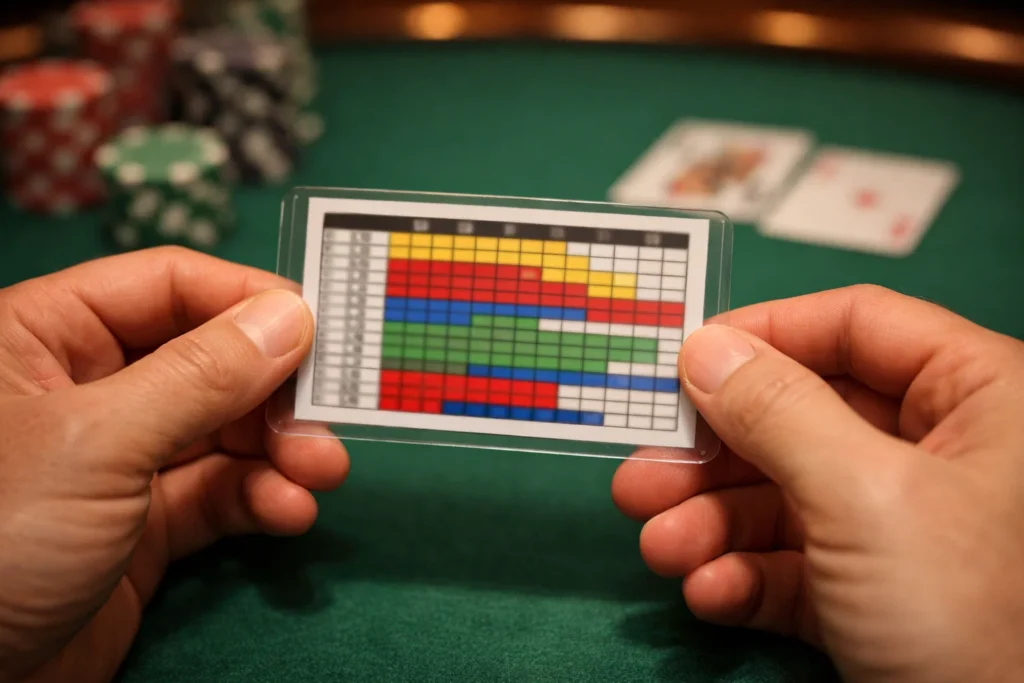
BTW, if you’re playing on your phone, you can easily pull up a quick reference to the cheat sheet. Feel free to do a screen of our strategy chart above (each move has its colour, so it’s easy to spot).
If we’re still speaking of…, I often get asked whether we can break the chart rules at all. Actually yes, but only when it makes sense, such as when you’re counting cards (in land-based casinos, mostly), when you’re playing a specific game (free bet blackjack, double exposure, or switch blackjack), or when table rules are crazy wild (no resplits allowed, few decks only, too many decks, or doubling after split not allowed).
Don’t overthink it; it’s usually the pros who take on the challenge. If you’re new to it all, just stick to the strategy chart.
Finally, a good strategy chart can help with the odds, but it’ll never replace common sense. So, don’t forget to set a clear budget and step away in time.

- Card Counting in Blackjack – Is Card Counting Illegal? - March 2, 2026
- Basic Blackjack Strategy Chart: Your Brief Chart Guide - February 17, 2026
- 10 Best Card Games to Play at UK Casinos (Not All Are Blackjack) - January 16, 2026