Why does a near-miss feel worse than losing right away? Or, why does a ‘limited’ bonus offer make you reach for your wallet?
Casino psychology is doing its thing. No, not a coincidence.
I’ll walk you through the subtle tricks casinos (try to) play on you. Not to scare you off (or hype anything up whatsoever), but to help you spot those hidden patterns you might not be aware of.
I’m all in for making informed decisions. What about you?
Why Casino Psychology, Really?
Casino psychology is a bunch of mental tricks gambling sites use to affect the way you decide, risk, and even react to rewards. No, it’s not mind control, but playing a teeny-tiny role in shaping your choices. This works out perfectly in the context of money, uncertainty, and excitement.
Cheeky cherry on top? Casino psychology thrives on decision-making under pressure. Add a few flashy banners, maybe a few timers, and a “last chance” sign – and there you have it. Let’s be real, you’re likely to say “yes” without even checking the odds.
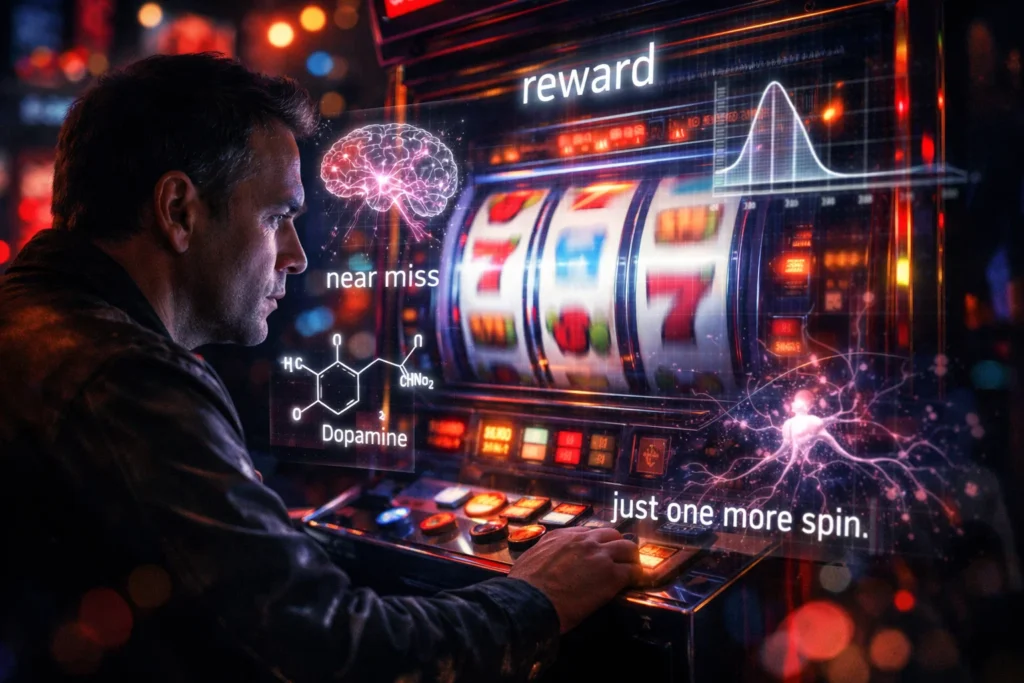
Final piece of the puzzle is something called the reward loop. Even tiny ones – wins trigger your dopamine (hello, the same brain chemical that triggers habit-forming behaviour). Throw a “you nearly won” at it, and you’ve got a loop. That’s when people think to themselves: “One more go.”
Do Casinos ‘Feel’ More Fun Than They Actually Are?
Often, yes. Online casinos are designed to hook your senses. Your wallet will follow suit. It’s all those flashing lights and big sounds that make it feel like a wild ride. Even if the odds might not be in your favour.
Above that, casinos also make small wins seem huge, while chatty tables give the fake impression that everyone’s about to win.
What does it bring us to? Time flies by, and casual players (who cannot spot patterns yet) get swept up in a few seconds.
Does it feel fun now?
How Slots Keep You Spinning?
Slots aren’t just random numbers. They’re also designed to hook you, and sometimes, even fool you. All this? It’s psychology.
Here’s what really happens:
Visual hooks: Those high-quality animations and sounds are there for a reason – to keep your brain busy and make losses sting less.
Bonus loops: Bonus rounds aren’t just some extra fun. They give you the idea that you can win even more ‘for free’. Sure.
Near-misses: When you almost hit the jackpot (your brain treats it like a real win). You don’t even notice when you start spinning again. It’s dopamine in action.
To sprinkle a little extra, it all happens way too fast for you to make informed decisions. And since 85% of players in Great Britain gamble for the chance to win big (Gambling Commission’s survey for 2024), they often let that desire win over smart decision-making.
Instead, check for:
- Volatility: High (rare big wins) or low (steady small prizes).
- RTP (Return to Player): 96% is industry’s average.
- Hit Frequency: At least higher than 30%.
- Max win: The bigger the better, but it usually means very long dry spells.
How Come ‘Almost Winning’ Feels Like Winning
It’s the brain (not the game’s maths) playing tricks. Even if it’s an almost-win, your brain reacts as if you’ve scored for real. What happens next is that it releases dopamine and makes that “so close” moment feel like an actual reward. But your wallet stays empty, remember?
The result? You’ll want to chase the next spin.
Now, casinos know this and use regular near misses to lure you in. Simple psychology as that.
Losses Disguised as Wins: Explain, Please
LDWs are when winning isn’t really winning.
Ok, ever seen a flashy WIN note, but your balance barely moved? That’s an LDW.
Say, you bet £1 on a spin and land a tiny combo worth 50p. And your slot goes crazy with a neon WIN sign screaming in your face. But you still lost 50p, right? Now, imagine all this in the long run.
How come you misread it every single time?
- Fast-paced play;
- Flashy graphics and sounds;
- Too celebratory animations;
- Your mind focuses on WIN, not on how much.
Why Bonuses Feel Like Free Cash
Casino bonuses (say a £100 welcome offer) might feel like a free gift at first. But it’s nothing but another psychological trick.
Why we fall for it:
Framing effect: Bonuses are displayed as something ‘extra’;
‘House money’: You’re more likely to bet bigger when you think it’s the casino’s cash, but it’s actually yours;
Wagering: It’s not only that you’re required to make a deposit first, but there are also wagering requirements – the number of times you have to wager your bonus before you cash out.
Gambler’s Fallacy (or why we think a win is ‘due’)
Long story short, the gambler’s fallacy is the ‘illusion’ that past game outcomes can affect future results. Something like: “Once it landed red four times in a row, it’s gotta be black next.” Familiar?
Let’s take roulette. Or no, coin flip – even easier. No matter what came up before, each toss is absolutely independent. Nothing owes you anything.
Next time you ‘almost’ fall for it, remember these:
- Probability can’t and doesn’t have a memory.
- We are wired to fall for patterns (even when there aren’t any.)
- Chasing a win (or loss) is your fastest way to empty your wallet. You don’t want that, do you?
Finally, Can You Outsmart Casino Psychology?
Yes, but only if you know how to spot the tricks (before they spot you). Even when casinos are pros at luring you in.
Here’s how:
- Know the tricks: Colourful visuals, popping banners, and countdowns are designed to push you (pause before you click).
- Check the info box: Games with high max wins look exciting, but they pay out rarely.
- Scan the T&Cs: Casinos like to hide important terms in boring fine print you never want to read.
- Stick to limits: Set deposit/loss limits before you play so you don’t end up chasing losses.
- Step away regularly: Even 10 minutes away will make you spot ‘just another’ casino trick.
I hope you understand that outsmarting a casino isn’t about beating the odds. But spotting red flags and making well-informed decisions? Yes, that’s what I’m talking about.
No one is ever rushing you, so take your time.
Now, a friendly nudge and a piece of healthy casino psychology tip before I go: Know your triggers. If casino games ever stop being fun, time to step away – that’s one very important part of a healthy casino psychology that everyone should follow.

- Gambling in the UK Through the Ages – A Historical Overview - August 24, 2026
- Bonus Terms in UK Online Casinos - August 24, 2026
- UKGC vs Offshore Casinos – What’s the Difference? - August 24, 2026