There's a reason the Martingale betting system has survived for centuries. It makes losing at roulette look like a temporary inconvenience.
Bet £5 on red. If you lose, bet £10. Lose again, go to £20. Keep doubling until red finally appears, and you'll recover everything you've lost, with £5 left over.
It's easy to see the appeal. You don't have to study the wheel, follow previous results or know much about roulette at all. Just keep doubling.
But the numbers get uncomfortable pretty quickly. Five losses leave you £155 down, and the next bet needs to be £160. You're now putting £160 on a single spin to make the same £5 you could have won on your first attempt.
And that's assuming the table lets you bet £160 in the first place.
How Does the Martingale Betting System Work?
Martingale is usually played on roulette's even-money bets: red or black, odd or even, and high or low. These pay 1:1, so each successful bet can cover the losses from the previous bets in that sequence.
You can start with any amount, although the size of your first bet makes an enormous difference to how quickly things escalate.
With a £1 starting bet, six consecutive losses cost £63. With £10, the same losing streak costs £630. The next bets would be £64 and £640 respectively.
Neither player is any closer to winning. They've simply reached very different levels of financial exposure.
The other rule is to return to your original stake after a win. That's how Martingale produces its characteristic pattern of small, repeated profits, interrupted occasionally by a much more expensive losing streak.
Why Do People Think Martingale Works?
Because much of the time, it appears to.
You might win your first bet. Or lose twice, double twice, and win the third. Either way, the sequence ends in profit.
If you repeat this enough times, you can build up a series of successful results. That makes the system feel dependable, particularly when you've recovered losses several times already.
But those wins don't tell you much about the next sequence.
If you've completed 20 successful Martingale sequences, each earning £5. You're £100 ahead. Then you hit six consecutive losses, starting at £5.
That sequence costs £315. Your earlier profits are gone, and you're now £215 down.
The system hasn't suddenly stopped following its rules. This is exactly how its rules work.
£100 gained − £315 lost = £215 down
The article's £5 starting-stake example. This is an invented sequence, not a forecast.
Can Martingale Beat the Roulette House Edge?
The problem isn't just the size of the bets. Roulette doesn't give you a genuine 50/50 chance of winning on red or black.
A European wheel has 18 red pockets, 18 black pockets and one green zero. That gives red a 48.65% chance of winning, with the remaining 51.35% covering black and zero.
The difference creates a house edge of 2.70%. On American roulette, which adds a double zero, the house edge rises to 5.26%.
You can find European roulette games with a La Partage rule, where half your stake is returned if zero lands on an even-money bet. That reduces the house edge to 1.35%, although the rule isn't available everywhere.
| Roulette version | House edge |
|---|---|
| European roulette | 2.70% |
| American roulette | 5.26% |
| European roulette with La Partage on qualifying even-money bets | 1.35% |
These differences matter when choosing a roulette game, but Martingale can't change them.
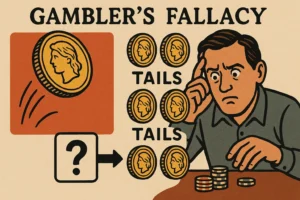
A £5 bet on red has exactly the same probability of winning as a £500 bet on red. And if black has appeared eight times consecutively, red still has the same chance on the next spin.
This is where some Martingale explanations become misleading. They treat an eventual win as though it's owed to the player after enough losses. Roulette doesn't work that way. Each spin starts with the same probabilities, regardless of what happened before.
How Many Losses Can Martingale Survive?
That depends on your balance, your starting stake and the table's maximum bet.
Let's say you have £200 and begin with £2. After six consecutive losses, you've spent £126. The next stake should be £128, but you've only got £74 remaining.
- £2 → £4 → £8 → £16 → £32 → £64Six losing bets cost £126 altogether.
- £74 remains£200 minus £126 leaves £74.
- £128 required nextThe remaining balance cannot fund the next doubling.
You could lower the next bet, but a £74 win wouldn't recover the £126 already lost. You could also deposit more, although that means increasing your exposure to continue a sequence that might still lose.
Yet - the table limit can stop you even sooner.
Imagine a roulette game with a £100 maximum on outside bets. Starting at £1, you can double through £2, £4, £8, £16, £32 and £64. Lose the £64 bet, and the next required stake is £128, which exceeds the maximum.
See where the doubling stops
Change the example amounts to see how many consecutive losing bets fit before the balance or table maximum stops the sequence.
After 7 consecutive losses
- Total lost
- £127.00
- Balance remaining
- £73.00
- Next required bet
- £128.00
The next £128.00 bet exceeds the £73.00 remaining balance and the £100.00 table maximum. The sequence stops here.
| Loss # | Stake lost | Total lost |
|---|---|---|
| 1 | £1.00 | £1.00 |
| 2 | £2.00 | £3.00 |
| 3 | £4.00 | £7.00 |
| 4 | £8.00 | £15.00 |
| 5 | £16.00 | £31.00 |
| 6 | £32.00 | £63.00 |
| 7 | £64.00 | £127.00 |
Illustration only: ordinary 1:1 payouts and consecutive full losses. It does not predict results or recommend a gambling budget. La Partage, pushes and different payouts need different calculations.
Some players look for tables with higher limits to avoid this restriction. That gives the sequence more room to grow, but also allows considerably larger losses.
The uncomfortable part is that a winning bet at the end of any of these sequences still earns only the original stake in overall profit.
How Likely Is a Long Losing Streak?
On European roulette, the probability of losing ten consecutive bets on red is about 0.13%, or roughly one in 800.
That's fairly unlikely for one particular sequence of ten spins. But someone playing roulette for hours, or returning regularly, has many opportunities to encounter losing streaks of this type.
A sequence of five or six losses is much less unusual. And those are already enough to make Martingale expensive, especially when the starting stake is £10 or £20.
You don't need to experience an extraordinary run of bad luck for the system to become difficult to maintain.
It's also easy to underestimate the cost because the early bets seem harmless. Losing £2, then £4, then £8 might not feel particularly serious. By the time you're considering £128 or £256, you're making a very different financial decision from the one you made at the beginning.
Are There Different Types of Martingale?
The classic Martingale system is only one version. Several variations change when you increase your stake or how much you add.
| System | Increase after | Reset or stop | Main drawback |
|---|---|---|---|
| Classic | Each loss: double the stake. | Return to the starting stake after a win. | A losing run quickly demands much larger bets. |
| Grand | Each loss: double, then add a fixed amount. | Return to the starting stake after a win. | Stakes rise faster than with classic Martingale. |
| Reverse | Each win: increase the stake. | Reset after a loss, or at a chosen win cap. | A loss can erase accumulated winnings. |
| Mini / capped | Each loss, up to a chosen cap. | Reset after a win; stop at the loss cap. | Reaching the cap means accepting the losses. |
Grand Martingale
Grand Martingale is more aggressive than the original. Instead of doubling after a loss, you double and add a fixed amount.
Starting with £10 and adding £2, your bets would be £10, £22, £46, £94 and so on.
A successful sequence produces more profit than classic Martingale, but the stakes rise faster too. It's difficult to see much benefit in making an already expensive progression even more demanding.
Reverse Martingale
Reverse Martingale increases bets after wins rather than losses.
Start with £10, win and increase to £20. Win again and move to £40. The aim is to make more money during a winning streak, then return to the starting stake after a loss.
It avoids chasing losses through progressively larger bets, but the accumulated winnings can disappear quickly. Losing that £40 bet after two wins would leave you £10 down overall.
Some versions reset after a fixed number of wins rather than waiting for a loss.
Mini Martingale
Mini Martingale puts a cap on the number of times you can double.
For example, you might stop after three consecutive losses instead of continuing until you recover everything.
This limits how much one progression can cost, provided you respect the cap. But it also means accepting that some sequences will end with a loss.
Of the three variations, this one is the easiest to combine with a predetermined spending limit, although it still offers no realistic mathematical advantage.
Can You Use Martingale on Blackjack or Slots?
The system is most closely associated with roulette because even-money bets have predictable payouts. Other casino games make the calculations less straightforward.
In blackjack, an ordinary winning hand generally pays 1:1, but you can also push, split pairs, double down or receive a different payout for a natural blackjack.
These possibilities interfere with the simple doubling sequence. Blackjack also rewards understanding basic strategy, which influences the game's expected return. Martingale doesn't replace that.
Slots are an even poorer match.
Let's assume you're playing a slot at £1 per spin. You lose, increase to £2, and receive a payout of £0.60. The spin has produced a winning combination, but you've still lost £1.40 on that wager.
Slot payouts vary enormously, so there's no consistent even-money win to recover previous losses. A doubling progression won't remove the house edge or guarantee that you'll recover previous losses.
Sports betting has a similar complication. At decimal odds of 2.00, a winning bet returns an amount equal to your stake as profit. At odds of 1.50, it returns only half your stake in profit.
Simply doubling after each loss won't necessarily recover what you've spent. You'd need a different progression, and that doesn't make the underlying bet more likely to win.
Do Online Casinos Allow Martingale?
Martingale isn't necessarily cheating, if anyone says so. You're changing the amount you bet, not interfering with the game.
However, casinos can impose betting limits and restrictions through their terms. Bonus offers may also prohibit certain betting patterns or limit the maximum stake allowed while using promotional funds.
The real issue is usually the table maximum. Even if the casino has no specific rule against Martingale, you may still eventually reach a stake the game won't accept.
Is Martingale Better Than Flat Betting?
With flat betting, you keep the same stake regardless of the previous result. Bet £5, lose, and your next bet is still £5.
That doesn't improve your odds, but it makes your spending easier to follow.
Martingale can produce more frequent small profits, which may make it feel more successful. The difference becomes obvious when a losing streak arrives. Flat betting doesn't suddenly require you to risk hundreds of pounds on a single spin.
However, neither approach can beat the roulette's house edge. For recreational play, though, fixed stakes are generally easier to manage within a set budget.
Should You Try the Martingale Betting System?
If you're curious about Martingale, try it out with virtual credits in a free roulette demo or work through the calculations yourself.
Following a few losing sequences is often enough to understand why the strategy has such a mixed reputation. The first few bets seem manageable, then the amounts start climbing far faster than the potential profit.
A demo won't prove whether the system is profitable, and virtual winnings can't be withdrawn. But it will let you see how the progression works without risking your real money.
Yet - if you decide to play online roulette for real money, choose your spending limit beforehand and stick to it. Don't increase your budget just because a betting sequence hasn't reached a winning spin, it may just never happen. Not until you've run out of budget.
FAQ
Does the Martingale betting system guarantee a profit?
No. A successful sequence of even-money bets recovers previous losses and earns the original stake as profit. But you can run out of money or reach the table limit before winning.
How much money do you need for Martingale?
There's no amount that guarantees success. Starting with £1, seven consecutive losses cost £127, and the next bet requires another £128. Larger starting stakes increase those amounts proportionally.
Can you use Martingale on online slots?
You can increase your stake after losing spins, but slot payouts don't follow the even-money structure required by classic Martingale. A winning combination might return less than your stake, so doubling doesn't reliably recover losses.
Is reverse Martingale safer?
It avoids increasing stakes immediately after losses, but a single unsuccessful bet can erase several previous wins. Limiting the number of increases can control the amount at risk, though it doesn't improve the game's odds.
Can Martingale work if you have unlimited money?
In a theoretical model with unlimited funds, no table limits and independent even-money bets, a winning result will occur eventually with probability one. Real players have finite balances, casinos impose limits, and the theoretical scenario doesn't offer a practical gambling strategy.

- World Cup 2026 – Best Betting Sites in the UK - October 21, 2026
- Top 7 UK Casino Sites with Daily Jackpots (Because Waiting a Week Is Long) - July 27, 2026
- 7 Best Live Casino Game Shows You’ll Actually Like (UK Picks) - August 24, 2026